
Blog
Top 10 Types of Equipment Parts Every Buyer Should Know
Equipment downtime rarely begins with a dramatic failure. It may start with a cracked hose, a clogged filter, or a bearing that grows warm during a long shift. For buyers, understanding equipment parts is not merely a catalog exercise; it helps connect a machine’s symptoms to a suitable replacement. This guide introduces ten common categories used across construction, agriculture, material handling, and industrial work. Designs and names vary by machine. Check the manual.
Filters, belts, bearings, seals, hoses, fasteners, pumps, electrical components, cutting edges, and undercarriage parts each serve distinct roles. A filter may help protect a hydraulic circuit from contamination, while a belt transfers motion between pulleys. Small differences matter. Before ordering, compare the machine model, part number, dimensions, operating conditions, and manufacturer guidance. Consider exposure to heat, vibration, dust, pressure, or repeated impact. A low purchase price can look attractive, yet fit, service life, availability, and warranty terms shape the real cost. That sounds straightforward. It isn’t always: older machines may have design revisions, substitutions, or incomplete records. When details conflict, verify them with a qualified supplier or equipment technician rather than guessing from a photo. No checklist replaces machine-specific documentation, but a careful comparison can help prevent avoidable returns and downtime. The sections ahead explain what each category does, where buyers commonly encounter it, and what to confirm before purchase.
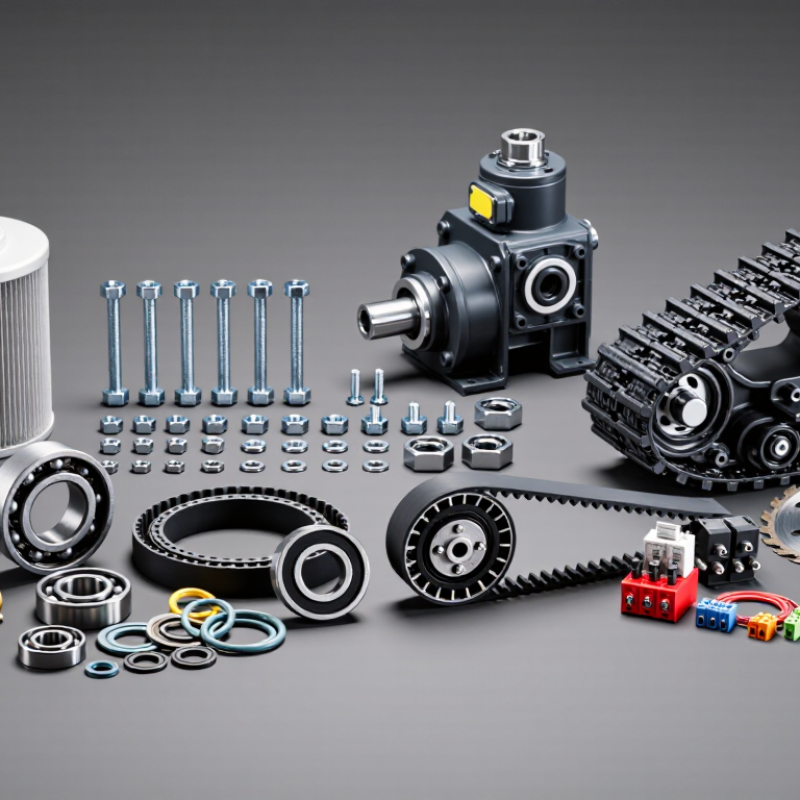
Bearings and Gears: ISO 281 Life Ratings and ISO 1328 Accuracy
When comparing bearings, treat an ISO 281 life rating as an estimate, not a service-life promise. The basic rating life, L10, represents a statistical life that 90% of a sufficiently large group of identical bearings are expected to reach or exceed under stated conditions. Load, speed, lubrication, and contamination can change actual performance. Small details matter. A bearing running beside a dusty conveyor may not match a calculation based on clean, well-lubricated operation. Ask whether the quoted figure is basic L10 life or a modified rating that accounts for operating conditions.
For cylindrical gears, ISO 1328 classifies accuracy through tolerances on tooth-flank deviations, including profile, helix, and pitch-related measurements. The specified accuracy grade helps buyers compare manufacturing precision, but it does not guarantee quiet running or long service life by itself. Alignment, surface finish, material, and lubrication matter too. Check which edition and measurement scope the supplier uses; similar-looking grades may not be directly comparable across different specifications. A gear report is useful. Still, it can leave questions: were measurements taken across the working face, and do they reflect the assembled gearbox?
Top 10 Types of Equipment Parts Every Buyer Should Know - Bearings and Gears: ISO 281 Life Ratings and ISO 1328 Accuracy
The bearing figures below are illustrative basic rating-life calculations, not product guarantees. ISO 281 basic rating life, L10, is expressed in millions of revolutions and corresponds to 90% reliability under the stated conditions.
| # | Equipment part | Typical application | Key buyer checks | Relevant standard | Illustrative rating or accuracy example | What the value means |
|---|---|---|---|---|---|---|
| 1 | Deep-groove ball bearing | Electric motors, fans and general-purpose machinery | Bore and outside diameter, radial load, speed, clearance, sealing and lubrication | ISO 281 for rating life | C = 30 kN; P = 5 kN; n = 1,500 r/min; L10 ≈ 216 million revolutions, or 2,400 hours | For a ball bearing, L10 = (C/P)3. The hour conversion assumes constant speed and load. |
| 2 | Angular-contact ball bearing | Pumps, machine-tool spindles and applications with combined loads | Contact angle, axial-load direction, preload, pairing arrangement and operating speed | ISO 281 for rating life | C = 25 kN; P = 4 kN; n = 900 r/min; L10 ≈ 244 million revolutions, or 2,714 hours | Illustrative ball-bearing calculation. Equivalent dynamic load P must reflect the actual radial and axial loads. |
| 3 | Cylindrical roller bearing | Gearboxes and electric motors with high radial loads | Bearing design, radial capacity, axial displacement needs, fit and lubrication | ISO 281 for rating life | C = 80 kN; P = 10 kN; n = 1,000 r/min; L10 ≈ 1,024 million revolutions, or 17,067 hours | For a roller bearing, L10 = (C/P)10/3. The example assumes constant operating conditions. |
| 4 | Tapered roller bearing | Vehicle hubs, reducers and shafts carrying combined loads | Load direction, mounting arrangement, endplay or preload, and lubrication | ISO 281 for rating life | C = 60 kN; P = 12 kN; n = 750 r/min; L10 ≈ 214 million revolutions, or 4,750 hours | Illustrative roller-bearing calculation. A paired arrangement and actual load distribution can affect P. |
| 5 | Spherical roller bearing | Conveyors, crushers and machinery subject to misalignment or heavy loads | Radial and axial loads, permissible misalignment, seals and contamination protection | ISO 281 for rating life | C = 120 kN; P = 20 kN; n = 600 r/min; L10 ≈ 392 million revolutions, or 10,900 hours | Illustrative roller-bearing calculation; misalignment, lubrication and contamination affect service life. |
| 6 | Spur gear | Parallel-shaft drives in reducers and conveyors | Module, tooth count, pressure angle, face width, material, backlash and lubrication | ISO 1328-1 for cylindrical gear accuracy; ISO 6336 for load capacity calculations | Example specified accuracy class: 7, subject to the applicable standard edition and inspection agreement | ISO 1328-1 classifies specified accuracy deviations; it is not a gear-life rating. Lower class numbers indicate tighter accuracy. |
| 7 | Helical gear | Quieter, higher-speed parallel-shaft gearboxes | Helix angle, thrust load, tooth geometry, surface finish, backlash and alignment | ISO 1328-1 for cylindrical gear accuracy; ISO 6336 for load capacity calculations | Example specified accuracy class: 6, with the measured deviations and inspection method agreed in the purchase specification | Accuracy class should be selected for the application; it does not by itself establish noise, strength or service life. |
| 8 | Bevel gear | Right-angle drives and differential assemblies | Gear type, shaft angle, tooth geometry, mounting distance, contact pattern and backlash | ISO 17485 provides an accuracy classification framework for bevel gears; confirm the specified scope and edition | State the required bevel-gear accuracy class and inspection criteria in the purchase specification | ISO 1328-1 covers cylindrical involute gears, so it should not be treated as the bevel-gear classification standard. |
| 9 | Worm gear set | Compact right-angle drives and applications requiring high reduction ratios | Ratio, center distance, thermal capacity, materials, lubrication and permissible backlash | Use the applicable worm-gear specification and inspection requirements; ISO 1328-1 is not a general worm-gear accuracy standard | Specify measurable tooth geometry, backlash limits, operating load and duty cycle | Worm-gear performance depends on sliding contact, heat generation and lubrication as well as geometry. |
| 10 | Planetary gear set | Compact reducers, robotics and mobile machinery | Ratio, torque, load sharing, backlash, carrier stiffness, lubrication and thermal limits | ISO 1328-1 may apply to individual cylindrical gears within scope; ISO 6336 can support relevant gear strength calculations | Specify the accuracy class for each applicable sun and planet gear, plus assembly-level backlash and runout limits | An assembly does not automatically have one ISO 1328 accuracy class; define component and assembled performance requirements separately. |
Buyer note: For ISO 281 calculations, p = 3 for ball bearings and p = 10/3 for roller bearings. Basic rating life does not account for every operating factor; reliability other than 90%, lubrication, contamination, mounting and actual duty conditions can change expected service life. Confirm the applicable standard edition, load data and inspection scope with the supplier.
Related Posts
-
Understanding the Importance of Con Equipment Parts in Modern Construction
-

Understanding the Importance of Quality Excavator Parts for Construction Efficiency
-
2025 Top Excavator Parts Guide for Optimal Performance and Durability
-
How to Choose the Right Equipment Parts for Your Needs?
-
China Top 10 Con Equipment Parts for Global Buyers?
-

What is construction equipment parts and how to choose them?